
FAQs for Thalassemia

FAQs for Thalassemia

By Dr. Shraddha Rajesh Walvekar MBBS DGO(Pune). Consultant Gynecologist NAMCO Charitable Hospital.
  1. How does Thalassemia affect menstrual Cycle? Answer: Puberty may be delayed or progress abnormally in teenagers with Thalassemia, due to iron build up impairing the function of the pituitary gland. This may lead to complications such as: Absence of menstruation, known as amenorrhea. Diminished functioning of the sex organs, known as hypogonadism.
  2. What should I do if I’m a carrier of Thalassemia and I want to get pregnant? Answer: Severe types of Thalassemia can cause a situation during a woman’s pregnancy. If you or your partner knows you are a carrier for Thalassemia, talk to your doctor or a genetic counselor before getting pregnant. Certain tests may be able to show which type of Thalassemia you are carrying. Once you are pregnant, prenatal testing can show whether or not your baby has Thalassemia.
  3. Can you get pregnant with Beta- Thalassemia? Answer: Yes, but you may need help getting pregnant. Often, women with beta Thalassemia will need to use medications to help them ovulate in order to become pregnant. Many health problems caused by beta Thalassemia.
  4. What is prenatal detection of Thalassemia? Answer: Preferably be carried out by CVS in the first trimester of pregnancy (10-12 weeks). Chronic villus sampling CVS utilizes either a catheter or needle to biopsy placental tissue derived from the same fertilized egg as the fetus.

Beta Thalassemia

Beta Thalassemia

By Dr. Pinky Shah (Kale) Pediatric Hematologist and Oncologist M.D.(Pediatrics) Fellow of National Board (Pediatrics Haematology & Oncology) IAP Fellow ( Ped.Hematology & Oncology)
Beta Thalassemia syndromes are a group of hereditary disorders characterized by a genetic deficiency in the synthesis of beta-globin chains of hemoglobin resulting in anemia.In the homozygous state, beta Thalassemia (ie, Thalassemia major) causes severe, transfusion-dependent anemia. In the heterozygous state, the beta Thalassemia trait (ie, Thalassemia minor) causes mild to moderate microcytic anemia. Patients in whom the clinical severity of the disease lies between that of Thalassemia major and Thalassemia minor are categorized as having Thalassemia intermediate. Several different genotypes are associated with Thalassemia intermedia. Treatment of beta Thalassemia major • Transfusion therapy Long-term transfusion therapy • Transfusion therapy Long-term transfusion therapy (in those with transfusion dependent beta Thalassemia) is a treatment used to maintain hemoglobin levels at a target pre-transfusion hemoglobin level of 9-10.5 g/dL (11-12 g/dL in those with concomitant heart disease).To ensure quality blood transfusions, the packed red blood cells should be leucoreduced. By having leucoreduced blood bags, the patient is at a lower risk to develop adverse reactions by contaminated white cells and preventing alloimmunisation. These regular transfusions promote normal growth, physical activities and suppress bone marrow hyperactivity. This strategy treats the anemia and suppresses endogenous erythropoiesis so that extramedullary hematopoiesis and skeletal changes are suppressed. Patients receiving long-term transfusion therapy also require iron chelation. • Iron chelation therapy The prevention of iron overload protects patients from morbidity and mortality. Every unit of transfused blood contains 200–250 mg of iron and the body has no natural mechanism to remove excess iron.The primary aim is to bind and remove iron from the body. Iron chelation is a medical therapy that may prevent the complications of iron overload. The excess iron can be removed by iron chelators- deferoxamine, deferiprone and deferasirox • Hematopoietic stem cell transplantation Allogeneic hematopoietic transplantation may be curative in some patients with Thalassemia major. ☐ Prevention Beta Thalassemia is a hereditary disease allowing for a preventative treatment by carrier screening and prenatal diagnosis. It can be prevented if one parent has normal genes, giving rise to screenings that empower carriers to select partners with normal hemoglobin. Thalassemia carrier screening programs have educational programs in schools, armed forces, and through mass media as well as providing counseling to carriers and carrier couples. Screening has shown reduced burden of disease.
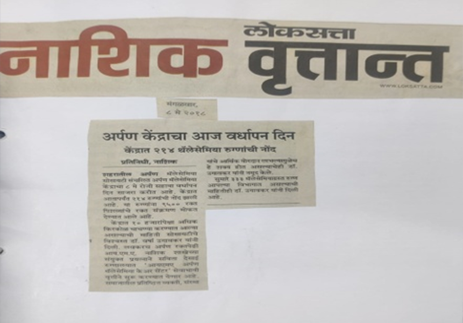
6th Anniversary of ATS.

6th Anniversary of ATS.

In ATS 214 Thalassemia children registered and nearly 9500 blood bags they have received. Various Dignitaries of society and corporate have given generous donations in the form of finances as well as blood donation on large scale so that we could give NAT tested safe blood to these children. Currently we have total 333 Thalassemia children registered at Nasik & Mumbai.
Leadership Award

Leadership Award

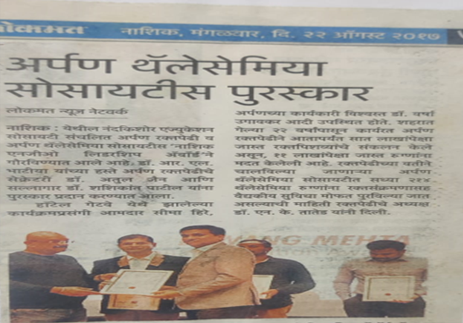
ATS received “Nashik NGO leadership Award “ at Hotel Gateway Taj . Arpan has collected more than 7000 Blood Bags and provided Blood & Component s to 11,000 patients. ATS is supported by Arpan Blood Bank. 214 children at Nashik are availing the treatment!
Free transfusion facilities at ATS

Free transfusion facilities at ATS

Date:22/8/2017
ATS received “Nashik NGO leadership Award “ at Hotel Gateway Taj . Arpan has collected more than 7000 Blood Bags and provided Blood & Component s to 11,000 patients. ATS is supported by Arpan Blood Bank. 214 children at Nashik are availing the treatment!
YouTube
LinkedIn
LinkedIn
Share
WhatsApp